
24 Sep 2026 · Data Engineering, Spark
Shuffle-Heavy Spark Jobs on Fabric Can Now Cost 40%+ Less
Efficient Scaledown (Preview) decouples shuffle from executor lifetime — 43% less compute in Microsoft's benchmark, and no code changes to try it.
If you work with Spark on Microsoft Fabric, you’ve probably seen this scene: the job finishes processing, but the cluster is slow to scale down because some nodes are “stuck” holding onto shuffle data. Efficient Scaledown, now in preview, targets exactly that problem — and it’s worth understanding what it is, why it matters, and how to try it.
1. What is it?
To understand why this feature matters, it helps to first understand what a “shuffle” actually is.
When Spark runs a job with a GROUP BY, a JOIN, or any operation that needs to bring related rows together, it can’t just process each executor’s data in isolation — rows belonging to the same group might be scattered across different executors. Spark solves this in two steps:
- Stage 1: each executor processes its own slice of data and writes it back to its local disk, organized by group.
- Stage 2: a different (or the same) executor reads — “fetches” — the blocks it needs over the network, from wherever they were written.
That write-and-redistribute step is the shuffle.
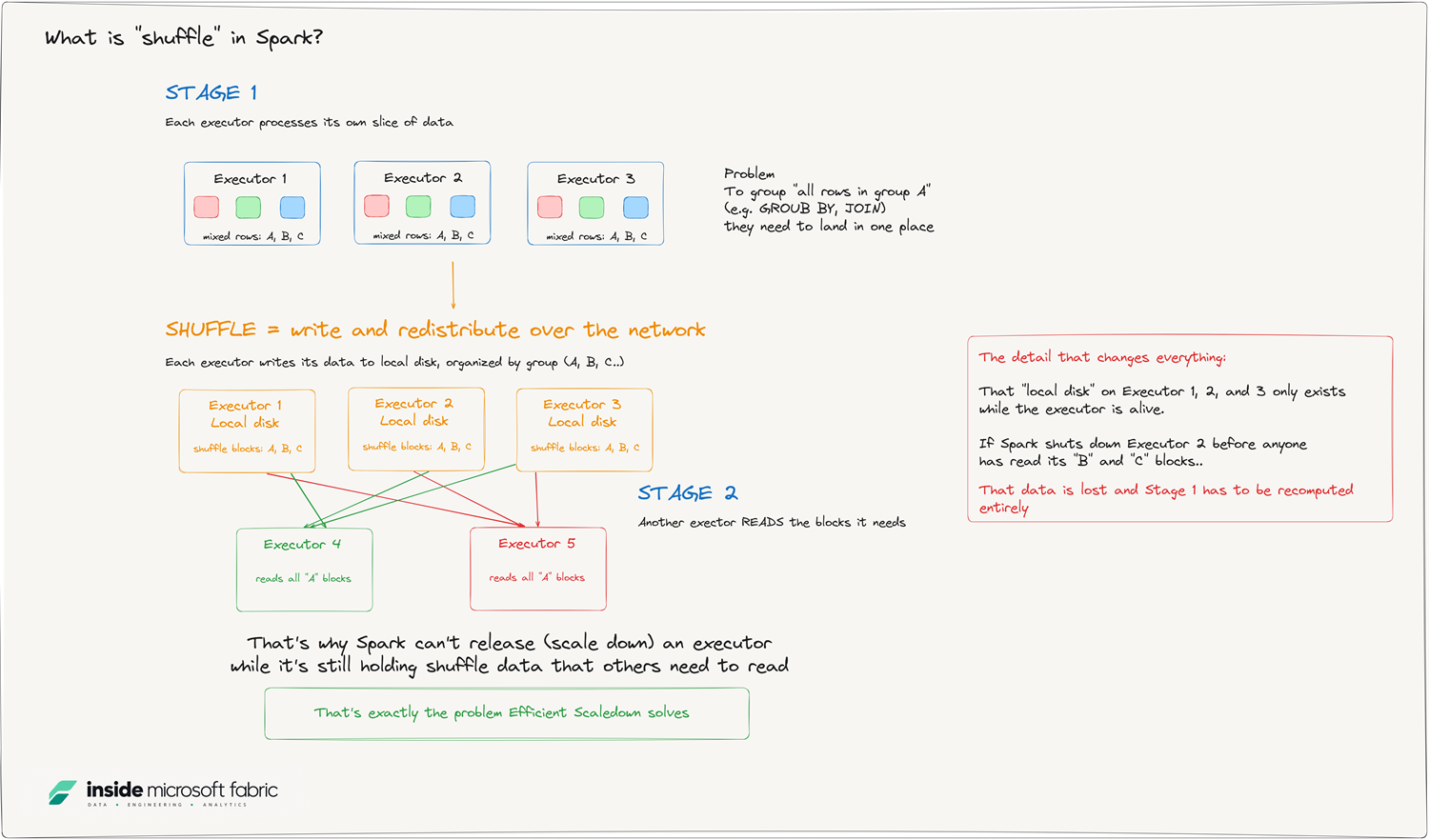
Here’s the detail that matters for everything that follows: that local disk only exists while the executor is alive. If Spark shuts down an executor before every consumer has read its shuffle blocks, that data is lost — and Spark has to recompute the entire stage that produced it.
This is exactly why Spark’s autoscaler can be so conservative about scaling down: it can’t safely release a node that’s still holding shuffle data someone might need. In practice, this shows up as “zombie executors” — nodes that have finished their own work but stay alive (and billed) simply because they’re holding onto data.
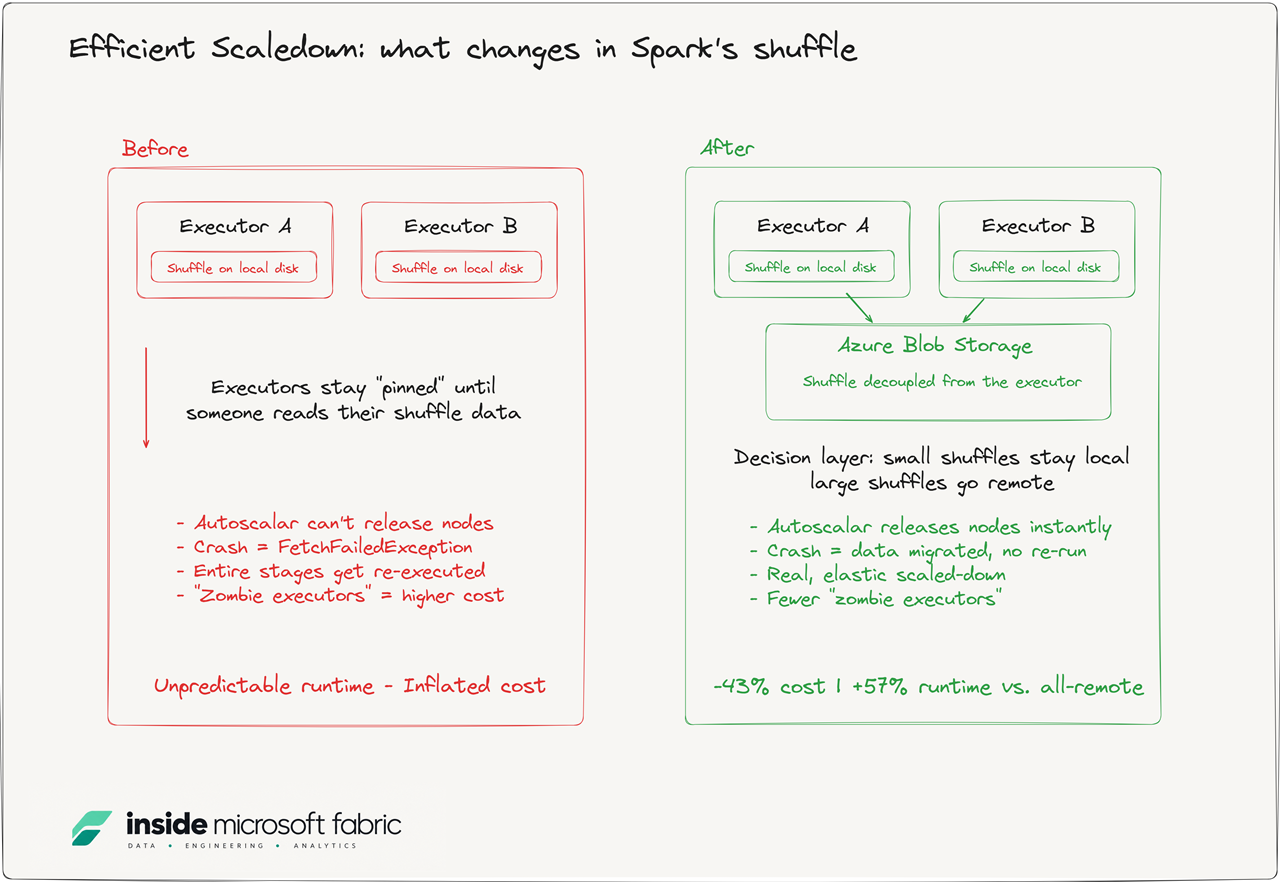
Efficient Scaledown breaks that coupling by routing shuffle to Azure Blob Storage instead of local disk, built on four pieces:
- Remote Shuffle Manager (RSM): reads/writes shuffle to remote Blob Storage.
- Shuffle Migration: migrates shuffle blocks before decommissioning a node, instead of losing them.
- Decision Layer: decides per stage, at runtime, whether shuffle stays local (fast) or goes remote (resilient) — small shuffles don’t pay the network tax, large ones get the safety net.
- AQE shuffle write: dynamically adjusts shuffle partition sizes for the best throughput.
2. Why is it interesting?
Three reasons, backed by Microsoft’s own benchmark (TPC-DS, Spark 4.1):
Cost. By releasing executors as soon as their own work is done — instead of keeping them alive until every last shuffle read completes — total compute dropped from 3,724 to 2,121 VM-minutes in the benchmark, a 43% reduction. For teams running large, autoscaled Spark workloads, that’s a direct line item.
Resilience. An executor crash, a spot-node preemption, or a transient network blip no longer forces the recomputation of entire stages, because shuffle data either survives in Blob Storage or gets migrated out before the node goes away. This matters most in environments that lean on cheaper, less stable compute (spot instances, aggressive autoscaling) — exactly the setups where this used to hurt the most.
Real elasticity. Because shuffle is no longer tied to executor lifetime, the autoscaler can shrink the cluster as aggressively as the workload allows, without artificial floors caused by “someone might still need this executor’s shuffle.” And because the Decision Layer is selective — sending only large shuffles remote, keeping small ones local — you avoid paying a network tax on every shuffle indiscriminately, which is what gets you the reported up to 57% better runtime compared to a blunt “send everything remote” approach.
Put together: lower cost, more predictable runtimes, and jobs that hold up better against the everyday failures of elastic cloud infrastructure.
3. How to implement it
Two prerequisites apply regardless of how you turn it on: Native Execution Engine (NEE) must be enabled, and you need Fabric Spark Runtime 3.5 or higher.
From there, you have two ways to enable it, depending on the goal.
A) Test mode — at the notebook level
Useful for piloting the change on a specific job without touching anything at the workspace level:
spark.conf.set("spark.remote.shuffle.enabled", "true")
spark.conf.set("spark.sql.rsm.decisionlayer.enabled.level", "stage")
spark.conf.set("spark.sql.adaptive.shuffleWrite.enabled", "true")
spark.conf.set("spark.storage.decommission.shuffleBlocks.enabled", "true")
spark.conf.set("spark.storage.decommission.shuffleBlocks.migrateToFallbackStorage", "true")
spark.conf.set("spark.dynamicAllocation.excludeDeltaSnapshotCache", "true")
A word of caution: some of these properties (NEE, dynamicAllocation, decommission) are read when the SparkSession starts, not afterward. That means running this via %run against another notebook — or packaging it into a .whl and importing it — doesn’t reliably work if the session is already running: a whl is Python code, not Spark session configuration, and it hits the same timing problem as %run. This approach is good for testing, not for adopting the feature as a standard.
B) Production mode — at the Environment level
This is the right way to make Efficient Scaledown the workspace’s default behavior:
- Create or edit an Environment in Fabric.
- Enable Native Execution Engine and set the Runtime to 3.5 or higher.
-
Add the same six properties under Spark properties:
Property Value spark.remote.shuffle.enabledtruespark.sql.rsm.decisionlayer.enabled.levelstagespark.sql.adaptive.shuffleWrite.enabledtruespark.storage.decommission.shuffleBlocks.enabledtruespark.storage.decommission.shuffleBlocks.migrateToFallbackStoragetruespark.dynamicAllocation.excludeDeltaSnapshotCachetrue - Publish the Environment and set it as the workspace default (or attach it per notebook).
With this approach, every Spark session that starts in that workspace is already born with Efficient Scaledown active — no dependency on someone remembering to run a setup cell.
One more practical note: if you use notebookutils.notebook.runMultiple() to fan out several notebooks in parallel, be aware they all share the same Spark session as the calling notebook, and therefore the same Environment — you can’t mix Environments within a single runMultiple call. If you need different notebooks to run under different Environments, that has to happen via separate pipeline activities instead.
4. What to expect
- It’s in Preview: validate it in dev/test first, not directly in production-critical pipelines.
- Which jobs actually benefit — this only matters for operations that trigger a shuffle in the first place:
- Shuffle-heavy (see the real gain):
JOIN(non-broadcast joins between large tables),GROUP BY/ aggregations, globalORDER BY/sort(),DISTINCT, explicitrepartition(), window functions withPARTITION BY. - Shuffle-light or none (won’t notice much):
filter,select,withColumn, and most other row-level transformations that stay within a partition — there’s nothing to redistribute, so there’s nothing for Efficient Scaledown to optimize.
So the bigger the shuffle, the bigger the payoff — jobs with large joins, wide aggregations, or TPC-DS-like patterns will see the most benefit; jobs that are mostly row-level transformations will barely notice it.
- Shuffle-heavy (see the real gain):
- Expect the clearest cost wins in environments with aggressive autoscaling and long-running sessions with idle gaps between queries — exactly where “zombie executors” used to accumulate.
- Expect fewer incidents of the “the job died from a transient failure and has to be relaunched from scratch” variety.
- No code, notebook, or pipeline logic changes are required — this is purely Spark configuration, which makes the pilot fast to set up and trivial to roll back if it doesn’t fit a particular workload.
A reasonable next step: enable it in a test Environment, run a real shuffle-heavy job before and after, and compare VM-minutes and scale-down time in the Monitoring Hub. The size of the win will depend heavily on how shuffle-heavy your actual workloads are — so it’s worth measuring on your own jobs rather than assuming the benchmark numbers translate directly.
Source: Microsoft Fabric Community Blog — More resilient Spark jobs with Efficient Scaledown (Preview)
Enjoyed this?
Get new articles like this one straight to your inbox.